
24/7 Emergency Flood Cleanup
24/7 Emergency Flood Cleanup San Diego
When water hits your property, clock speed matters. Our 24/7 Emergency Flood Cleanup operations activate instantly—stabilizing the loss, protecting your structure, and accelerating return-to-service. Below is a transparent, action-oriented playbook you can rely on during the first chaotic hours, through dry-down, and into full restoration.
Why immediate action wins
Water migration compounds by the minute. Within hours, drywall wicks moisture, subfloors swell, and microbial risk escalates. Our 24/7 Emergency Flood Cleanup model prioritizes rapid triage, moisture control, and verifiable documentation—so insurers, property managers, and homeowners have clean data and clear next steps.
Core value pillars
Speed-to-site: Live dispatch, real-time routing, and arrival ready to work.
Containment-first: Stop the source, isolate wet zones, and protect unaffected areas.
Dry-down science: Calibrated extraction, negative pressure, and climate control to hit dry standards fast.
Proof-of-dry: Daily moisture mapping and photos to validate every decision.
Seamless handoff: From 24/7 Emergency Flood Cleanup into rebuild with minimal downtime.
What to do before our team arrives (first 10–30 minutes)
Shut off water/power in affected areas if safe.
Protect high-value items: move electronics, documents, rugs, and loose textiles.
Create safe pathways: remove trip hazards; keep pets/kids out of wet zones.
Do not run household fans over visible contamination (sewage/gray water); wait for professional containment.
Document with photos/video—angles, rooms, and close-ups around baseboards and cabinetry.
Our rapid-response workflow
1) Arrival & triage
Verify safety, utilities, and category of water (clean, gray, black).
Deploy extraction systems and set perimeter containment.
Start initial moisture readings and thermal imaging to define the true wet footprint.
2) Extraction & controlled demolition (as needed)
Weighted extraction for carpets/pads where salvageable.
Remove non-restorable materials (e.g., swollen baseboards, non-salvage pad).
Bag-and-tag debris for chain-of-custody and insurance clarity.
3) Structural dry-down & dehumidification
Engineer dehumidifier/air mover ratios to meet target grains-per-pound (GPP).
Create pressure differentials to prevent cross-contamination.
Daily meter readings, photo logs, and documented adjustments.
4) Cleaning & antimicrobial protocols
Clean residues and apply appropriate antimicrobial agents—especially after gray/black water.
HEPA vacuuming of work zones once dry benchmarks are met.
5) Validation & handoff to rebuild
Final moisture verification against IICRC-aligned targets.
Scope any required rebuild (drywall, trim, paint, flooring) with transparent estimates.
Throughout each phase we communicate status, next best actions, and insurer-friendly documentation. This is the backbone of our 24/7 Emergency Flood Cleanup service promise.
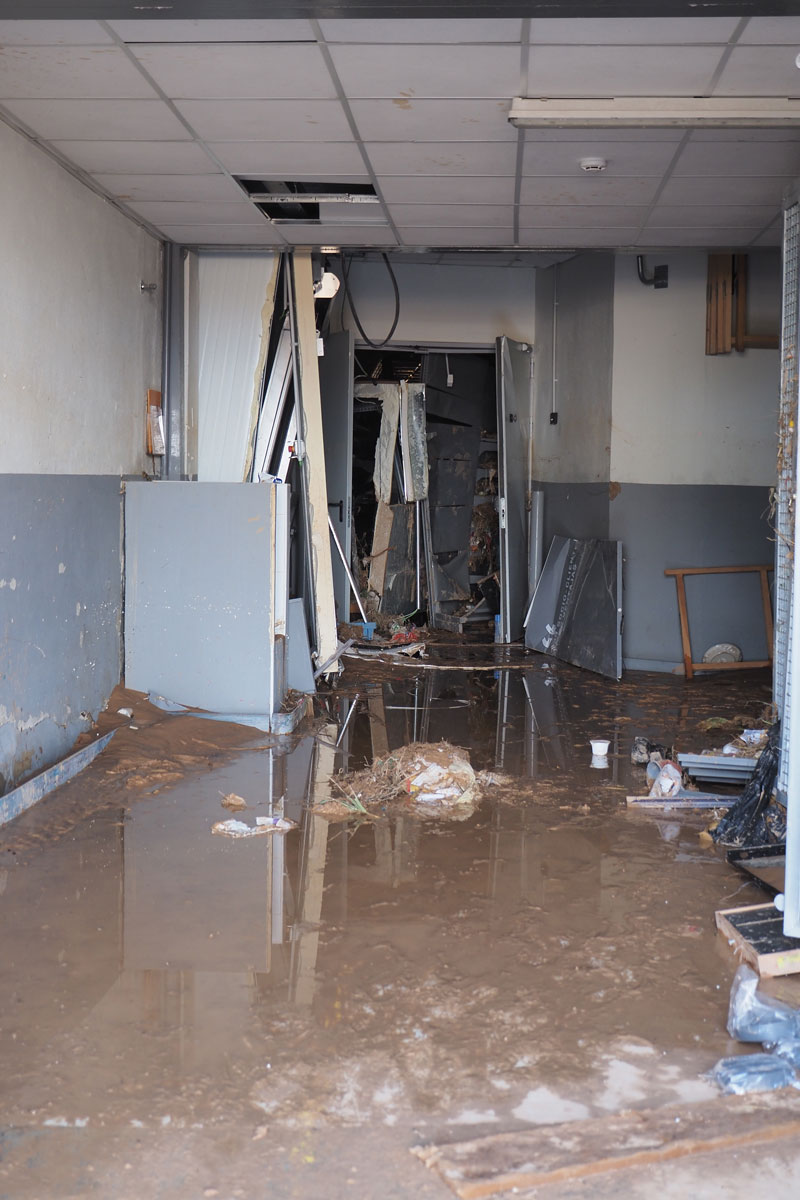
Service matrix at a glance
| Phase | Primary Objectives | Typical Equipment | Measurable Outcomes |
|---|---|---|---|
| Triage & Containment | Safety, source control, zone isolation | PPE, barriers, shutoff tools | Hazard cleared, wet footprint defined |
| Extraction | Remove bulk water quickly | Truck-mounts, weighted extractors, sub-surface tools | Standing water eliminated |
| Dry-Down | Accelerate evaporation and capture humidity | LGR/Desiccant dehumidifiers, air movers, inject-dry systems | Daily RH/GPP trending to target |
| Sanitize/Clean | Remove residues, control microbes | Antimicrobials, HEPA vacuums | Surfaces clean, odor downtrend |
| Validation | Prove dry and safe | Moisture meters, thermal imaging | Passed moisture benchmarks |
| Rebuild | Restore finishes and function | Trades per scope | Space returned to pre-loss or better |
This matrix aligns with the operational cadence of 24/7 Emergency Flood Cleanup and ensures stakeholders see progress that can be measured—not just promised.
Time-to-stabilization expectations
| Milestone | Target Window* | What You’ll Notice |
|---|---|---|
| Arrival & setup | 60–90 minutes from dispatch (conditions permitting) | Containment up, extraction underway |
| Bulk water removed | First 2–6 hours | Standing water gone; slip risks reduced |
| Environmental control | Day 1 | RH and GPP trending downward |
| Typical dry-down | 3–5 days | Consistent moisture reductions; equipment noise normal |
| Final validation | End of dry-down | Pass on meter readings; odor minimal |
| Rebuild start | After validation | Repairs scheduled with clear scope |
*Actuals vary by severity, materials, and environmental conditions. The critical path remains constant with our 24/7 Emergency Flood Cleanup methodology: stabilize, dry, sanitize, validate, rebuild.
Get a Free Quote
Every minute counts. Our certified team is available 24/7 to extract water, dry structures, and start restoration fast.
Common loss scenarios—and how we handle them
Supply-line bursts (kitchen, bath, laundry)
Rapid shutoff, toe-kick removal, cabinet cavity drying with injectors.
Laminate and MDF components assessed for delamination and replaced if required.
Slab or foundation seepage (heavy storms)
Perimeter containment, negative pressure to isolate intrusions.
Flooring decisions (float vs remove) based on material permeability and saturation curves.
Roof leaks
Source isolation with temp covers if needed; ceiling venting or controlled removal.
Priority drying of insulation and attic cavities to prevent secondary damage.
Sewer backup (black water)
Strict containment and PPE; non-porous salvage only.
Disinfection, removal of impacted porous materials, comprehensive sanitation.
Each scenario uses the same backbone of 24/7 Emergency Flood Cleanup but with nuanced tactics for materials, water category, and risk.
Insurance coordination without the headache
We provide photo logs, meter readings, floor plans, and line-item scopes that speak your carrier’s language. You focus on decisions—we supply the documentation trail that supports coverage determinations and faster approvals. This operational rigor is baked into our 24/7 Emergency Flood Cleanup deliverable.
Equipment you may see (and why it matters)
LGR/Desiccant Dehumidifiers: Capture airborne moisture to drive RH down and speed dry times.
High-velocity Air Movers: Create surface evaporation; positioned to avoid dead zones.
Inject-Dry Systems: Target wall/under-cabinet cavities without excessive demolition.
HEPA Filtration: Scrubs particulates during demolition and cleanup phases.
Thermal Imaging & Moisture Meters: Identify hidden wet areas and verify progress.
These tools let our 24/7 Emergency Flood Cleanup teams convert chaos into a controlled, measurable process.
Odor control and post-dry hygiene
After dry-down, lingering odor often signals residues rather than moisture. We pair deep cleaning with targeted odor remediation (activated media, hydroxyl/ozone where appropriate under controlled conditions). The objective: a space that not only tests dry—but feels healthy to occupy.
Preventing mold the right way
Mold prevention is about speed, containment, and humidity control. Our 24/7 Emergency Flood Cleanup approach keeps RH and GPP in a safe range, removes non-restorable materials promptly, and sanitizes remaining surfaces—cutting off the conditions mold needs to proliferate.
Commercial properties and multi-family workflows
Business continuity and resident satisfaction drive the playbook:
After-hours mobilization with discrete staging.
Zoned drying plans to keep units/areas operational where feasible.
Daily stakeholder briefings so asset managers can communicate proactively.
Phase-based invoicing to align with internal controls and insurer requirements.
This is 24/7 Emergency Flood Cleanup built for portfolios, not just single addresses.
Environmental and safety controls you can expect
PPE usage matched to water category and materials.
Lock-out/tag-out where electrical or mechanical hazards exist.
Containment barriers and pressure management to protect clean areas.
Waste handling compliant with local regulations.
Safety is non-negotiable—another cornerstone of our 24/7 Emergency Flood Cleanup promise.
Flood DAMAGE FAQS
How fast can you start?
Can you save my hardwood floors?
Will there be demolition?
What about my insurance?
How long will equipment run?
Is it safe to stay in the home?
What if odors linger after drying?
Do you handle reconstruction?
Can you help prevent future incidents?
What makes your approach different?
Cost transparency: what drives the estimate
| Cost Driver | Why It Matters | Optimization Tactic |
|---|---|---|
| Affected square footage | More area requires additional time and equipment | Tight containment minimizes the drying footprint |
| Water category | Gray or black water increases safety and sanitation protocols | Early classification and targeted demolition |
| Material types | Porous versus non-porous materials affect salvage potential | Preserve viable materials and remove time-intensive losses |
| Access & utilities | Limited access slows equipment setup and monitoring | Pre-clear access paths and verify utility availability |
| Duration to discovery | Longer saturation increases scope and secondary damage | Rapid 24/7 Emergency Flood Cleanup response |
Your next best step
If your property is wet right now, momentum is everything. Smart Dry Restoration’s 24/7 Emergency Flood Cleanup team will stabilize, dry, and document your loss so you can move forward with confidence—faster.
