
Mold Remediation vs Mold Removal
Which One Actually Saves Your Home?
Mold remediation is almost always the better choice for San Diego homeowners, because it addresses the moisture source and prevents regrowth — while mold removal only wipes out what’s currently visible. The terms get used interchangeably in marketing, but they describe two very different levels of service. If you’re comparing mold remediation vs mold removal because you’ve spotted a stain on a wall or a musty smell after a leak, understanding the difference now can save you from paying for the same problem twice. Below, we break down what each process actually involves, what it costs, and which one fits your situation.
Understanding Mold Removal
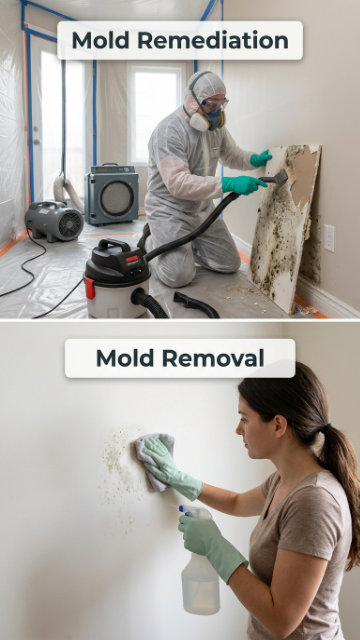
Mold removal refers to the physical act of eliminating visible mold growth from a surface. This can be as simple as scrubbing a shower tile with a mold-killing spray, wiping down a windowsill, or using a bleach solution on a small patch of drywall. It’s a surface-level intervention aimed at what you can see and smell right now.
How it works: A technician (or homeowner) applies an antimicrobial or bleach-based cleaner directly to the affected surface, scrubs or wipes away the growth, and lets the area dry. There’s typically no investigation into moisture source, no containment barriers, and no air quality testing involved.
Typical costs: For small, DIY-manageable spots — think a 2-3 square foot patch on tile grout or a windowsill — removal can cost nothing beyond a bottle of cleaner (roughly $10-$20). Professional spot-removal services in San Diego generally run $300-$800 for isolated, cosmetic jobs with no underlying water intrusion.
Core benefits: It’s fast, cheap, and gets rid of unsightly staining or odor immediately. For genuinely minor, surface-only mold — like the kind that forms on bathroom caulk from everyday humidity — this can be a perfectly adequate fix.
Ideal use cases: Small, isolated mold spots under 10 square feet, with a known and already-resolved moisture cause (e.g., you already fixed the leaky faucet), and no porous material involvement (drywall, insulation, subfloor). If you’re unsure whether a spot qualifies, a quick mold inspection can confirm it before you reach for a spray bottle.
Understanding Mold Remediation
Mold remediation is a comprehensive, systematic process that treats mold as a symptom of an underlying moisture problem — not just a cosmetic issue. It’s the industry-standard approach used by certified restoration companies and is what’s typically required after any meaningful water damage event, whether that’s a slow pipe leak, roof intrusion, or flooding.
How it works: Remediation starts with an inspection and, often, moisture mapping to find every place water has traveled — not just where mold is visible. Technicians then set up containment (plastic sheeting and negative air pressure) to stop spores from spreading to unaffected rooms, use HEPA air scrubbers, physically remove and dispose of contaminated porous materials (drywall, insulation, carpet padding), treat structural surfaces with EPA-registered antimicrobials, and dry the space using industrial dehumidifiers and air movers. Many jobs conclude with a post-remediation clearance test to confirm spore counts are back to normal. This full process is what’s typically referred to as mold remediation in San Diego, and it’s distinct from the surface cleaning most people picture when they hear “mold removal.”
Typical costs: In the San Diego area, mold remediation for a contained, single-room job typically runs $1,500-$5,000, depending on square footage and how much demolition is required. Larger jobs involving crawl spaces, HVAC contamination, or extensive drywall replacement can run $6,000-$10,000+. Insurance often covers remediation when it’s tied to a covered water damage event — always check your policy.
Core benefits: True remediation stops the problem at its source, meaning you’re far less likely to see mold return in six months. It also protects indoor air quality for household members with allergies, asthma, or other respiratory sensitivities, which matters year-round given how humid San Diego’s coastal microclimates and older stucco construction can get behind walls. Pairing remediation with professional moisture and leak detection is often what actually keeps the problem from returning.
Ideal use cases: Mold following any water damage event, mold covering more than roughly 10 square feet, mold in HVAC systems or wall cavities, recurring mold that keeps coming back after DIY cleaning, or any situation involving black mold (Stachybotrys) or an unknown moisture source. These are exactly the scenarios our mold damage restoration team is built to handle.
- IICRC Certified Experts
- 24/7 Rapid Response
- Insurance Approved & Hassle-Free
- Competitive Pricing Guaranteed
Side-by-Side Comparison
| Attribute | Mold Removal | Mold Remediation |
|---|---|---|
| Upfront Cost | $10–$800, from DIY to minor spot-treatment | $1,500–$10,000+ depending on scope |
| Scope of Work | Surface cleaning of visible mold only | Full source investigation, containment, removal, drying, and clearance testing |
| Moisture Source Addressed | Rarely | Always the starting point |
| Long-Term Effectiveness | Low — regrowth is common if the source isn’t fixed | High — designed to prevent recurrence |
| Air Quality Impact | Minimal improvement; can spread spores if disturbed without containment | Significant improvement via HEPA filtration and containment |
| Insurance Coverage | Rarely covered | Frequently covered when tied to a qualifying water damage claim |
| Best For | Small, cosmetic, already-dry spots | Any mold tied to water intrusion, hidden cavities, or recurring growth |
Pros and Cons Breakdown
Pros of Mold Removal
- Inexpensive — often just the cost of a cleaning product or a small service call.
- Fast — can be completed in under an hour for small areas.
- Low disruption — no containment setup or displaced furniture required.
Cons of Mold Removal
- Doesn’t address the cause — if there’s an active leak or high humidity behind the surface, mold typically returns within weeks or months.
- Can spread spores — scrubbing dry mold without containment can aerosolize spores into HVAC systems and other rooms.
- No verification — there’s no testing to confirm the problem is actually resolved, which can be a liability if you’re selling the home.
Pros of Mold Remediation
- Solves the root problem — moisture source identification prevents the mold from simply reappearing.
- Protects health — containment and HEPA filtration reduce spore exposure for people with respiratory sensitivities.
- Documentation for insurance and resale — clearance testing and reports provide a paper trail buyers, lenders, and adjusters often want to see.
Cons of Mold Remediation
- Higher upfront cost — a legitimate concern for homeowners on a tight budget, though insurance frequently offsets this.
- More time-intensive — a full remediation job can take several days to a week depending on drying times.
- Some disruption to the home — containment barriers and equipment noise are part of the process while work is underway.
Which Option Is Better? The Ultimate Showdown
The honest answer is that mold removal and mold remediation aren’t really competing options — they solve different problems, and the right choice depends almost entirely on scope and cause.
Choose mold removal if: the mold patch is small (under roughly 10 square feet), it’s on a non-porous surface like tile or glass, and you already know — and have already fixed — the moisture source. A ring of mildew on bathroom caulk that reappears because of everyday shower steam is a reasonable candidate for routine cleaning rather than a full remediation contract.
Choose mold remediation if: the mold followed any kind of water event (a burst pipe, roof leak, appliance overflow, or flooding), if it’s spread across drywall, insulation, subfloor, or other porous materials, if you can smell a musty odor without a visible source, or if you simply don’t know what caused it. In San Diego specifically, older homes with slab foundations and stucco exteriors are prone to hidden moisture intrusion behind walls — cosmetic mold removal in these cases almost always leaves the actual problem untouched, and it tends to come back within a single rainy season. This is also why timely water mitigation prevents mold growth in the first place: the faster the moisture is addressed, the less likely mold is to establish itself at all.
From a cost perspective, remediation looks more expensive on paper, but the comparison isn’t apples-to-apples. A $400 removal job that doesn’t fix the underlying leak often turns into a $3,000 remediation job six months later, plus whatever structural damage accumulated in the meantime. When mold is tied to real water intrusion, remediation is the cheaper option in the long run — not the more expensive one. Learning to recognize the common signs of mold growth early can help you catch the problem before it reaches that point.
Get a Mold Assessment in San Diego
If you’re not sure whether your situation calls for a quick clean or a full remediation plan, the safest first step is a professional inspection — guessing wrong can mean paying twice. Smart Dry Restoration offers mold assessments across San Diego to help homeowners understand exactly what they’re dealing with before committing to a service. Visit our mold testing in San Diego page to request a consultation, or check whether your policy applies by reading how homeowners insurance covers mold remediation services in San Diego before moving forward.
Conclusion & Recommendation
For small, cosmetic, already-dry mold spots with no history of water damage, mold removal is a fast and reasonable fix. But for anything tied to a leak, flood, hidden moisture, or recurring growth — which describes the majority of real-world mold cases in San Diego homes — mold remediation is the only approach that actually resolves the problem rather than masking it temporarily. For a closer look at what to expect price-wise either way, our breakdown of mold removal and remediation cost in San Diego covers real-world ranges in more detail. When in doubt, start with an inspection rather than assuming which category your situation falls into.
Authoritative sources
The guidance on this page is consistent with the following public health and federal sources. Each link goes to the original document.
- EPA — A Brief Guide to Mold, Moisture and Your Home — Sets the widely used threshold that mold covering more than about 10 square feet should be handled professionally, and advises drying wet materials within 24 to 48 hours to prevent growth.
- CDC — About Mold and Your Health — Links damp indoor environments to respiratory symptoms including coughing, wheezing and congestion, and notes that people with asthma, allergies or weakened immune systems may react more severely.
- EPA — Why is mold growing in my home? — Confirms that mold requires moisture to grow indoors and that controlling the moisture source is what prevents recurrence.
Restoration work on this page follows the IICRC S500 Standard for Professional Water Damage Restoration and, where mold is involved, the IICRC S520 Standard for Professional Mold Remediation — the industry consensus standards that define drying targets, containment and clearance.
Every minute counts. Our certified team is available 24/7 to extract water, dry structures, and start restoration fast.
Frequently Asked Questions
Is mold remediation the same as mold removal?
No. Mold removal is surface-level cleaning of visible mold, while mold remediation is a full process that identifies the moisture source, contains the area, removes contaminated materials, and verifies the fix with testing.
How do I know if I need remediation instead of just cleaning?
If the mold followed a water event, covers more than about 10 square feet, is on porous material like drywall or carpet, or keeps coming back after cleaning, you likely need remediation rather than simple removal.
Can I do mold removal myself in San Diego?
For small, isolated patches on non-porous surfaces with a known and resolved moisture source, DIY cleaning with an appropriate antimicrobial product is generally safe. Larger or recurring mold, or mold in HVAC systems, should be handled by professionals.
Does homeowners insurance cover mold remediation in San Diego?
It depends on the cause. Mold remediation tied to a sudden, covered water damage event, like a burst pipe, is often covered. Mold from long-term neglect or lack of maintenance typically is not. Check your specific policy or ask your adjuster.
How long does mold remediation take?
A single contained room typically takes 3 to 7 days, factoring in containment setup, removal, structural drying, and clearance testing. Larger or multi-room jobs can take longer.
Will mold come back after remediation?
Not if the moisture source has been fully corrected. Preventing recurrence is the entire purpose of remediation, which is why identifying the moisture source and drying the structure are core parts of the process.
What is the cost difference between mold removal and mold remediation?
The two sit in different brackets because they are different scopes of work. As the comparison table above sets out, removal covers small cosmetic spot treatment, while remediation covers containment, material removal, structural drying and clearance testing. The variables that decide where a specific job lands are the affected area, the category of water involved, whether the material is porous, and how accessible the growth is. An on-site assessment is the only way to get an accurate figure.
Is black mold always a remediation situation?
Yes. Black mold, or Stachybotrys chartarum, is treated as a remediation-level concern regardless of the size of the visible patch, due to the health risks associated with prolonged exposure.
Does the San Diego climate make homes more prone to mold?
Coastal humidity, marine layer moisture, and common slab-and-stucco construction can trap moisture behind walls in San Diego homes, especially in bathrooms, kitchens, and rooms with poor ventilation, making hidden mold more common than expected.
Who should I call first if I find mold after a leak?
Start with a mold inspection or assessment rather than jumping straight to cleaning. This confirms the scope of the problem and whether removal or full remediation is the appropriate next step.
