
DIY Water Cleanup vs Professional Restoration
Which One Actually Saves Your Home (and Your Money)?
When water hits your floors, the clock starts ticking before you’ve even found a towel. For minor spills caught within an hour, DIY water cleanup can work — but for anything involving standing water, drywall, or flooring, professional restoration is almost always the safer, cheaper long-term choice, because hidden moisture left behind by DIY water cleanup is the single biggest cause of costly mold claims. This guide breaks down exactly when each approach makes sense, what it actually costs, and how San Diego homeowners can make the right call before damage spreads — whether it’s a washing machine flood clean up or a full-blown flooded room.
Understanding DIY Water Cleanup
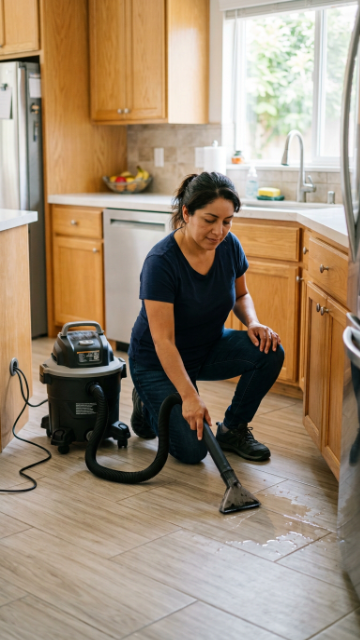
DIY water cleanup means handling water intrusion yourself — mops, wet/dry shop vacuums, box fans, and maybe a rented dehumidifier from the local hardware store. It’s the instinctive first response most San Diego homeowners reach for when a washing machine hose lets go or a small roof leak appears after a rare winter storm.
How it works: You extract visible water, run fans and a dehumidifier for a few days, and visually check for dryness. Total upfront cost typically runs $50–$300 for equipment rental or purchase, plus your own time — often 8 to 20 hours spread over several days.
Core benefits: Immediate action, no waiting for a technician, and low out-of-pocket cost for small, contained incidents. If you catch a spill within the first 24–48 hours and it hasn’t touched drywall, subfloor, or insulation, DIY water cleanup can genuinely resolve the problem.
Ideal use cases: A dishwasher overflow contained to tile, a small window leak during a San Diego rainstorm, or a spilled fish tank — situations where water didn’t sit long enough to wick into building materials.
The catch: Consumer-grade equipment can’t measure moisture inside walls or under flooring the way professional moisture and leak detection tools can, which means “looks dry” and “is dry” are often two very different things.
Understanding Professional Restoration
Professional restoration is a structured, insurance-recognized process performed by IICRC-certified technicians using industrial extraction equipment, hygrometers, thermal imaging, and commercial-grade air movers and dehumidifiers.
How it works: Technicians assess the water category (clean, gray, or black water) and class of damage, extract standing water with truck-mounted equipment, then set targeted drying equipment and monitor moisture levels daily with data logging until materials reach an industry-standard dry standard — usually 3 to 5 days. Learn more about the full water damage restoration service process and what’s included at each stage.
Typical costs: Professional water damage cleanup generally ranges from $1,200 to $5,000+ depending on square footage, water category, and how many materials require replacement — though many San Diego insurance policies cover the bulk of this when the damage is sudden and accidental.
Core benefits: Documented moisture readings for insurance claims, prevention of secondary mold growth, structural drying that reaches subfloors and wall cavities DIY tools can’t access, and a clear paper trail if you later sell the home.
Ideal use cases: Burst pipes, flood damage cleanup, basement flood cleanup, sewage backups, or any water damage affecting flooring, drywall, or insulation.
- IICRC Certified Experts
- 24/7 Rapid Response
- Insurance Approved & Hassle-Free
- Competitive Pricing Guaranteed
Side-by-Side Comparison
Before you decide, it helps to see both approaches head-to-head — especially if you’re also weighing whether sewage cleanup or a category 3 water event is involved, since that changes the calculation entirely.
| Attribute | DIY Water Cleanup | Professional Restoration |
|---|---|---|
| Upfront Cost | $50–$300, equipment or rental | $1,200–$5,000+, often insurance-covered |
| Drying Accuracy | Surface-level, visual guesswork | Instrument-verified moisture mapping |
| Time to Resolution | 2–7 days, uncertain results | 3–5 days, documented completion |
| Mold Prevention | Limited; hidden moisture is common | High; hidden cavities dried and monitored |
| Insurance Documentation | None | Full moisture logs and photo reports |
| Best For | Minor, surface-only spills | Standing water, floods, and category 2/3 water |
| Equipment Used | Shop vac and box fans | Truck-mount extractors, industrial dehumidifiers, and thermal imaging |
Pros and Cons Breakdown
Pros of DIY Water Cleanup
- Fast to start — no waiting for a technician to arrive
- Low upfront cost for genuinely minor incidents
- Simple for surface spills that never reached porous materials
Cons of DIY Water Cleanup
- No way to verify hidden moisture in walls, subfloors, or insulation, and no easy way to fully rescue soaked padding the way professional carpet cleaning equipment can
- Higher long-term risk of mold, warping, and structural rot
- No documentation for insurance if damage resurfaces later
- Time-intensive and physically demanding without commercial equipment
Pros of Professional Restoration
- Instrument-verified drying eliminates guesswork
- Insurance-ready documentation protects you financially
- Faster structural drying with commercial-grade equipment
- Mold prevention built into the process, not an afterthought
Cons of Professional Restoration
- Higher upfront cost, though often offset by insurance
- Requires scheduling a technician visit, even if most San Diego crews offer 24/7 emergency response
- May feel like overkill for genuinely minor spills
Which Option Is Better? The Ultimate Showdown
The real question isn’t “which is cheaper on day one” — it’s “which is cheaper over the next five years.” DIY water cleanup wins on upfront cost for small, contained incidents. But the moment water touches drywall, carpet padding, hardwood, or subfloor, professional restoration becomes the financially smarter choice, because undetected moisture is what turns a $300 DIY afternoon into a $10,000 mold remediation bill.
Choose DIY water cleanup if: the spill was small, contained to non-porous surfaces (tile, sealed concrete), and fully addressed within an hour or two.
Choose professional restoration if: water sat for more than a few hours, touched carpet or drywall, came from a “dirty” source (sewage, appliance overflow, storm flooding), or if you’re unsure how far it spread — which, given San Diego’s mix of older homes with plaster walls and newer builds with engineered hardwood flooring, is more common than most homeowners expect.
San Diego’s dry climate is actually part of the trap: because humidity is normally low, homeowners assume moisture will “just evaporate” on its own. It often doesn’t — not from inside a wall cavity or under vinyl plank flooring. That false sense of security is exactly why so many DIY water cleanup attempts end up needing mold remediation or mold testing a few weeks later.
Ready to Protect Your San Diego Home?
If you’re not 100% sure whether your situation calls for DIY water cleanup or professional restoration, don’t guess with your home’s structure. Smart Dry Restoration offers fast, San Diego-based water damage restoration and rapid disaster response to give you a clear answer — and a documented one, in case you need it for insurance. Reach out for a consultation before a small leak becomes a big problem.
Authoritative sources
The guidance on this page is consistent with the following public health and federal sources. Each link goes to the original document.
- EPA — A Brief Guide to Mold, Moisture and Your Home — Sets the widely used threshold that mold covering more than about 10 square feet should be handled professionally, and advises drying wet materials within 24 to 48 hours to prevent growth.
- CDC / NIOSH — Mold, Testing and Remediation — States that thorough visual inspection and musty odour are more reliable indicators than air sampling, and recommends drying wetted materials within 48 hours or removing them.
- EPA WaterSense — Fix a Leak Week — Reports that the average household wastes more than 9,300 gallons a year to leaks, that 9% of homes have leaks wasting 50 gallons or more per day, and that fixing them can cut a water bill by about 10%.
Restoration work on this page follows the IICRC S500 Standard for Professional Water Damage Restoration and, where mold is involved, the IICRC S520 Standard for Professional Mold Remediation — the industry consensus standards that define drying targets, containment and clearance.
Conclusion & Recommendation
DIY water cleanup has its place — for small, surface-level spills caught quickly, it’s a perfectly reasonable first response. But for anything involving standing water, porous materials, or an unknown source, professional restoration isn’t a luxury; it’s what actually prevents the damage from becoming permanent. When in doubt, get a professional moisture assessment before deciding — it’s the one step that determines whether DIY water cleanup vs professional restoration was ever really a choice at all.
Every minute counts. Our certified team is available 24/7 to extract water, dry structures, and start restoration fast.
Frequently Asked Questions
1. Can I do water damage cleanup myself, or do I need a professional?
It depends on scope. Minor, surface-only spills caught within an hour or two can often be handled with DIY water cleanup. Anything involving standing water, carpet, drywall, or an unknown source is safer left to professional restoration.
2. How long can water sit before it causes mold in a San Diego home?
Mold growth can begin within 24 to 48 hours in the right conditions, even in San Diego's typically dry climate, especially inside enclosed wall cavities or under flooring where airflow is limited.
3. Is professional water damage restoration covered by homeowners insurance?
Many policies cover sudden, accidental water damage such as burst pipes, though coverage varies by policy and cause. A restoration company's documentation is often required to support a claim.
4. What's the difference between water damage restoration and water damage cleanup?
Cleanup typically refers to removing visible water, while restoration includes structural drying, moisture verification, and repair of any affected materials to return the space to its pre-damage condition.
5. Can I rent the same equipment restoration companies use?
Consumer rental equipment is generally far less powerful than truck-mounted extraction units and commercial dehumidifiers, and rental locations rarely offer the moisture-mapping tools needed to verify hidden dryness.
6. How do I know if water damage has reached my subfloor or walls?
You generally can't tell by looking or touching. Professional moisture meters and thermal imaging are needed to detect moisture trapped behind walls or under flooring.
7. What should I do first if I discover a flood in my home?
Shut off the water source if possible, avoid electrical hazards, and begin extracting standing water immediately. For anything beyond a small spill, contact a professional restoration company right away rather than waiting to see if it dries on its own.
8. Does San Diego's climate make DIY water cleanup safer than in humid regions?
Not necessarily. While low ambient humidity can help surface moisture evaporate faster, it does little for water trapped inside walls, subfloors, or insulation, which is where most hidden mold problems start.
9. How much does professional water damage restoration typically cost in San Diego?
Costs generally range from $1,200 to $5,000 or more depending on the size of the affected area, water category, and materials involved, though insurance often covers a significant portion for sudden, accidental damage.
10. What happens if I attempt DIY cleanup and it doesn't fully dry the area?
Residual moisture can lead to mold growth, warped flooring, and deteriorating drywall over time, often resulting in a larger and more expensive repair than if a professional had assessed the damage initially.
