
Repairing Water Damage vs Replacing Materials
How to Protect Your Home Without Overspending
When water invades your home, you’re immediately faced with a high-stakes decision: repairing water damage vs replacing materials. In most cases, repair is the faster, more cost-effective choice for materials exposed to clean water for under 48 hours, while replacement becomes necessary once contamination, mold, or structural weakening set in. The right answer depends on the water source, how long materials stayed wet, and what those materials are made of.
This guide breaks down both paths so San Diego homeowners can make an informed, confident decision — whether you’re dealing with a slow leak under the sink or a full-scale flood.
Understanding Water Damage Repair
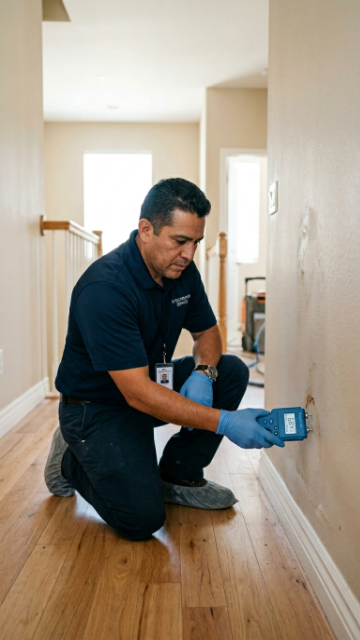
Repairing water damage means restoring existing materials — drywall, subflooring, hardwood, cabinetry — to a safe, dry, and structurally sound condition rather than tearing them out. Professional water damage restoration typically follows a structured process: water extraction, industrial dehumidification, antimicrobial treatment, and monitored drying using moisture meters to confirm materials have returned to a safe moisture content.
Repair works best when damage is caught early. Clean water (a burst supply line, an overflowing tub) that’s addressed within the first 24 to 48 hours rarely requires demolition. Drywall can often be dried in place rather than cut out, hardwood floors can be saved with specialized hardwood floor drying techniques, and cabinetry frequently survives if it’s dried and treated quickly.
Cost-wise, repair is almost always the more economical route. A typical water damage cleanup for a contained, clean-water incident in a San Diego home might run several hundred to a few thousand dollars, depending on the square footage affected and how quickly a technician arrives. Repair also minimizes disruption — most homeowners can stay in their homes during the drying process, and there’s no need to source matching materials, coordinate contractors, or wait weeks for replacement flooring to be installed.
The core benefit of repair is preservation: original hardwood, custom cabinetry, or period-specific trim in an older San Diego bungalow can often be saved rather than replaced with something that doesn’t quite match.
Understanding Material Replacement
Replacement means removing damaged materials entirely and installing new ones. This becomes necessary — not optional — once water damage crosses certain thresholds: prolonged saturation (typically 48+ hours), contamination from Category 2 (gray water) or Category 3 (black water, including sewage backups), or visible structural compromise like swelling, warping, or delamination.
Materials like particleboard subflooring, laminate flooring, and drywall with paper backing are especially vulnerable — once saturated, they lose structural integrity and become a breeding ground for mold, even after drying. In these cases, drying the material doesn’t restore it; it just delays the inevitable.
Replacement costs more upfront than repair, both in materials and labor, and timelines are longer — often one to several weeks depending on permitting, material sourcing, and contractor availability. For flooring, cabinetry, or drywall replacement, homeowners should also budget for finish work: painting, trim, and matching existing materials where possible.
The benefit of replacement is certainty. When materials are compromised, replacing them eliminates the risk of hidden mold growth, structural failure, or a musty odor that never quite goes away. It’s also the only responsible option after significant flood damage or contaminated water exposure, where health and safety — not just cost — are the priority.
- IICRC Certified Experts
- 24/7 Rapid Response
- Insurance Approved & Hassle-Free
- Competitive Pricing Guaranteed
Side-by-Side Comparison
| Attribute | Repairing Water Damage | Replacing Materials |
|---|---|---|
| Upfront Cost | Lower — typically a few hundred to a few thousand dollars for contained incidents | Higher — materials, labor, and finish work add up quickly |
| Timeline | Days, with drying typically taking 3–5 days | 1–4+ weeks depending on scope and permitting |
| Best For | Clean water caught within 24–48 hours | Contaminated water, prolonged saturation, or structural damage |
| Long-Term Risk | Low, if drying is verified with moisture meters | Very low — new materials eliminate hidden mold risk |
| Disruption to Household | Minimal — often livable during the process | Significant — may require temporary relocation |
| Aesthetic Outcome | Preserves original materials, finishes, and character | Clean slate, but may require matching existing decor |
| Insurance Considerations | Often falls under standard mitigation coverage | May require separate claims for reconstruction |
Pros and Cons Breakdown
Pros of Repairing Water Damage
- Lower cost — no need to purchase and install entirely new materials
- Faster turnaround — most drying cycles complete within a week
- Preserves original character — especially valuable in older San Diego homes with custom trim or hardwood
- Less disruptive — homeowners can often remain in the home throughout the process
Cons of Repairing Water Damage
- Not viable for contaminated water — repair alone can’t neutralize sewage or gray water risks
- Hidden moisture risk — improperly dried materials can develop mold weeks later
- Limited lifespan extension — repaired materials may not last as long as new ones
Pros of Replacing Materials
- Eliminates contamination risk entirely — critical after sewage or long-term flooding
- Extends long-term durability — new materials come with a fresh lifespan
- Opportunity to upgrade — a chance to install more water-resistant materials
Cons of Replacing Materials
- Higher cost — materials, labor, and permitting add up
- Longer timeline — can take weeks, especially for flooring or cabinetry
- More disruptive — may require temporary relocation during construction
Which Option Is Better? The Ultimate Showdown
There’s no universal winner in the repairing water damage vs replacing materials debate — the right call depends on three factors: water category, duration of exposure, and material type.
Choose repair if: the water source was clean (a supply line, appliance overflow, or rainfall intrusion), the affected area was dried within 24–48 hours, and the materials involved are solid wood, tile, or standard drywall without visible warping. In these scenarios, professional moisture and leak detection followed by controlled drying is almost always the more cost-effective and less disruptive path.
Choose replacement if: the water was contaminated (sewage, floodwater, or water that sat for several days), materials are particleboard, laminate, or paper-backed drywall, or there’s visible swelling, delamination, or a persistent musty smell that suggests mold has already taken hold. At that point, spending money on repair is a false economy — you’ll likely pay for both the failed repair and the eventual replacement.
Budget also plays a role. If a San Diego homeowner is working with a tight insurance deductible, a qualified restoration technician can often assess in real time which specific materials are salvageable and which need to go, rather than making a blanket repair-or-replace decision for the whole space. This hybrid approach — repairing what can be saved, replacing what can’t — is frequently the most financially sound outcome.
Local Considerations for San Diego Homeowners
San Diego’s coastal climate and older housing stock add a few wrinkles to this decision. Homes near the coast often deal with higher ambient humidity, which can slow natural drying and make professional dehumidification more important than it would be in a drier inland climate. Many San Diego neighborhoods also feature homes built before modern moisture-resistant materials were standard, meaning original hardwood and plaster may require more delicate, specialized repair techniques than a straightforward replacement job. And because much of San Diego’s older plumbing infrastructure is aging, drain maintenance and early leak detection go a long way toward avoiding repair-vs-replace decisions altogether.
If your water damage stems from a washing machine flood or a basement flood, the same repair-vs-replace logic applies — the deciding factor is always contamination level and how long materials sat wet before professional intervention.
Get a Professional Assessment Before You Decide
Every water damage situation is different, and the fastest way to avoid overspending — or under-treating a hidden problem — is a professional inspection. Smart Dry Restoration offers on-site assessments for San Diego homeowners to determine exactly which materials can be repaired and which need replacing, backed by moisture readings rather than guesswork. If you’re dealing with active water damage, contact our water damage restoration team for a fast, no-pressure evaluation.
Authoritative sources
The guidance on this page is consistent with the following public health and federal sources. Each link goes to the original document.
- EPA — A Brief Guide to Mold, Moisture and Your Home — Sets the widely used threshold that mold covering more than about 10 square feet should be handled professionally, and advises drying wet materials within 24 to 48 hours to prevent growth.
- CDC / NIOSH — Mold, Testing and Remediation — States that thorough visual inspection and musty odour are more reliable indicators than air sampling, and recommends drying wetted materials within 48 hours or removing them.
- EPA WaterSense — Fix a Leak Week — Reports that the average household wastes more than 9,300 gallons a year to leaks, that 9% of homes have leaks wasting 50 gallons or more per day, and that fixing them can cut a water bill by about 10%.
Restoration work on this page follows the IICRC S500 Standard for Professional Water Damage Restoration and, where mold is involved, the IICRC S520 Standard for Professional Mold Remediation — the industry consensus standards that define drying targets, containment and clearance.
Conclusion & Recommendation
The repairing water damage vs replacing materials decision ultimately comes down to how quickly you act and what the water actually touched. Clean water caught early almost always favors repair — it’s cheaper, faster, and preserves your home’s original character. Contaminated or long-standing water damage almost always requires replacement to protect both your home’s structure and your family’s health. When in doubt, a professional moisture assessment removes the guesswork and ensures San Diego homeowners aren’t paying for more — or less — than the situation actually requires.
Every minute counts. Our certified team is available 24/7 to extract water, dry structures, and start restoration fast.
Frequently Asked Questions
1. How do I know if water damage can be repaired instead of replaced?
If the water was clean (not sewage or floodwater) and materials were dried within 24–48 hours, repair is usually possible. Visible swelling, warping, or a persistent musty smell are signs replacement is needed instead.
2. Is repairing water damage cheaper than replacing materials?
Yes, in most contained, clean-water situations, repair costs significantly less than full replacement, since it avoids new materials, labor, and finish work.
3. How long does water damage repair typically take?
Professional drying for a contained clean-water incident usually takes three to five days, though larger areas or high humidity can extend that timeline.
4. Can hardwood floors be repaired after water damage, or do they need replacement?
Hardwood can often be saved if it's dried quickly using specialized techniques, but prolonged saturation or cupping usually means sections need replacement.
5. What types of water damage always require replacement?
Damage from sewage backups, prolonged flooding, or any Category 3 (black water) contamination generally requires replacement due to health and structural risks.
6. Does homeowners insurance cover repair or replacement differently?
Coverage varies by policy, but mitigation and drying are often covered under standard water damage claims, while reconstruction may fall under a separate line item — check with your adjuster.
7. How can I tell if mold has already developed under damaged materials?
A persistent musty odor, discoloration, or materials that stay damp longer than expected are common signs. A professional moisture inspection can confirm hidden mold before you decide.
8. Is it safe to repair drywall after water damage, or should it always be replaced?
Non-paper-backed or water-resistant drywall can often be dried and repaired, but standard paper-backed drywall that's been saturated for more than 48 hours is prone to mold and usually needs replacement.
