
Mold Remediation Cost Guide
Mold Remediation Cost Guide for San Diego Homeowners
If you’ve spotted mold, smelled a musty odor, or dealt with a recent leak or flood, one of the first questions you’re probably asking is: how much is this going to cost to fix? This Mold Remediation Cost Guide is built specifically for San Diego homeowners and property managers who want a clear, honest understanding of what drives mold remediation pricing before they call anyone out to their property.
At Smart Dry Restoration, we’ve spent years helping San Diego families and businesses navigate mold problems, from small bathroom growth to widespread contamination following water damage restoration events. This guide walks through what affects cost, what the remediation process actually involves, and how to know when it’s time to bring in a certified professional rather than attempt a DIY fix.
Why This Service Matters
Mold isn’t just a cosmetic nuisance. Left untreated, it can spread behind walls, under flooring, and into HVAC systems, often growing in places you can’t see until the damage is extensive. In San Diego’s coastal climate, humidity, ocean air, and older housing stock with limited ventilation can all create conditions where mold takes hold faster than homeowners expect.
The risks go beyond property damage. Mold exposure can aggravate allergies, asthma, and other respiratory sensitivities, which is why prompt action matters for the health of everyone in the building. There’s also a financial angle: unaddressed mold can lower property value, complicate a home sale, and in some cases affect insurance claims down the line. Understanding remediation costs upfront helps homeowners make informed decisions instead of delaying treatment out of uncertainty.
Common Problems This Service Solves
Mold remediation addresses a wide range of real-world situations we see regularly across San Diego properties:
- Post-leak or post-flood mold growth — Mold often appears within 24 to 48 hours after a pipe burst, roof leak, or flood damage cleanup event if moisture isn’t fully removed.
- Musty odors with no visible source — A persistent smell often means mold is growing inside walls, under flooring, or in a crawl space.
- Bathroom and kitchen mold — Poor ventilation in high-moisture rooms is one of the most common causes of recurring mold in San Diego homes.
- Basement and crawl space contamination — Below-grade spaces are especially vulnerable, particularly after a basement flood cleanup situation.
- HVAC-related mold spread — Mold spores can travel through ductwork, spreading contamination to rooms that never experienced direct water intrusion.
- Real estate transaction concerns — Buyers and sellers frequently request mold assessments before closing, especially in older San Diego neighborhoods.
If any of these sound familiar, it’s worth having a professional take a closer look before the problem grows, literally and financially.
Our Service Process
Every mold remediation project at Smart Dry Restoration follows a structured, transparent process designed to protect your property and your health:
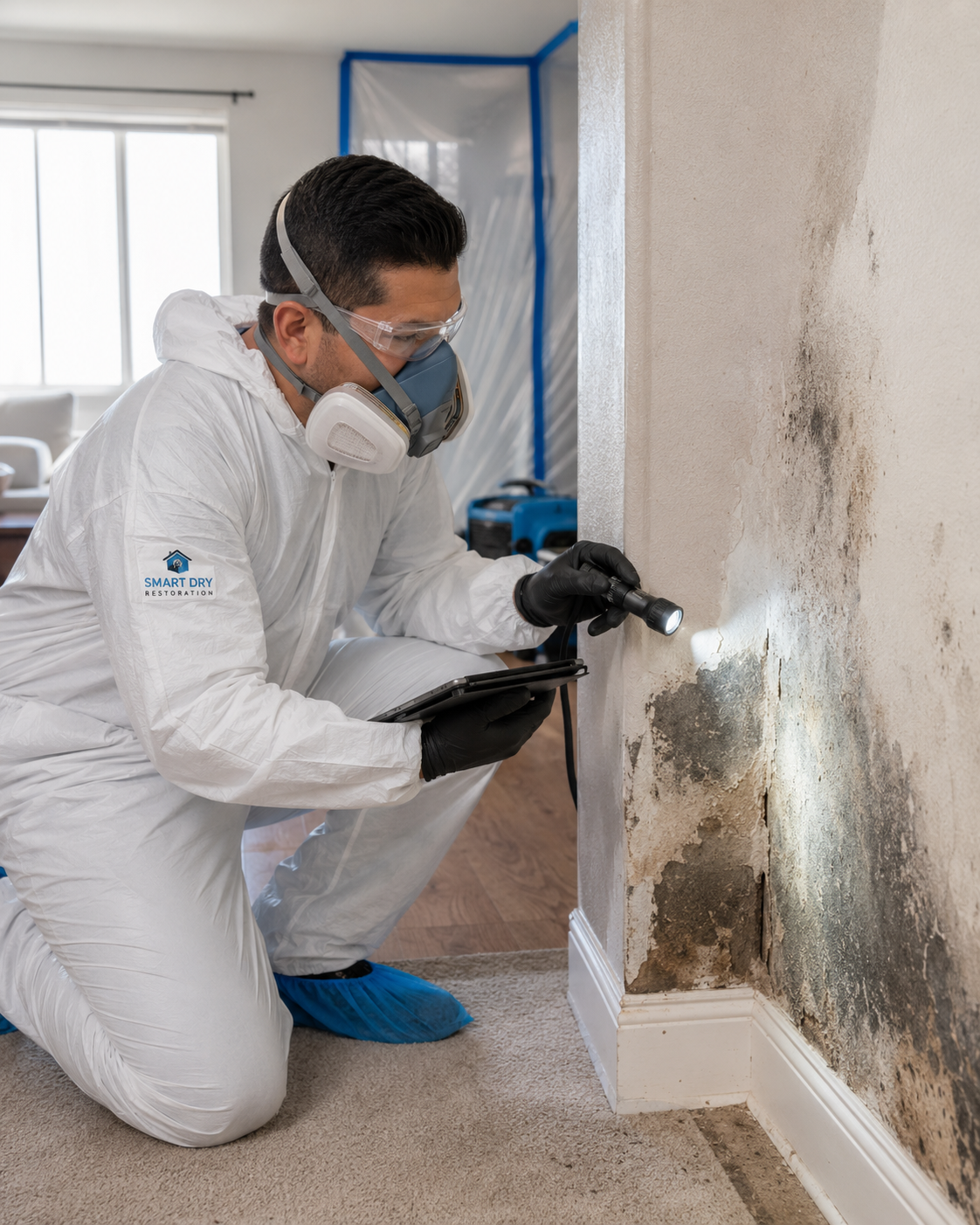
- Initial Assessment and Inspection — We evaluate the extent of mold growth, identify the moisture source, and determine whether mold testing is needed to confirm species and severity.
- Containment — Affected areas are sealed off using physical barriers and negative air pressure to prevent spores from spreading to unaffected parts of the property.
- Air Filtration — HEPA air scrubbers run continuously throughout the project to capture airborne mold spores.
- Removal of Contaminated Materials — Porous materials that can’t be fully cleaned, such as drywall or insulation, are safely removed and disposed of according to industry guidelines.
- Cleaning and Antimicrobial Treatment — Remaining surfaces are cleaned and treated with EPA-registered antimicrobial solutions to eliminate residual spores.
- Drying and Moisture Control — Since mold can’t grow without moisture, we use professional drying equipment to bring humidity levels back to a safe range, similar to our approach with moisture and leak detection services.
- Final Verification — A post-remediation inspection confirms the affected area meets clearance standards before we consider the job complete.
This same disciplined process applies whether we’re handling a small bathroom issue or a larger-scale mold damage restoration project tied to a prior water event.
- IICRC Certified Experts
- 24/7 Rapid Response
- Insurance Approved & Hassle-Free
- Competitive Pricing Guaranteed
Why Choose Smart Dry Restoration
San Diego homeowners choose Smart Dry Restoration because we treat every mold problem with the seriousness it deserves. Our technicians follow industry-standard remediation protocols, use commercial-grade containment and drying equipment, and communicate clearly at every stage of the project so you’re never left guessing what’s happening in your home.
We understand that mold problems are stressful, especially when they follow an already difficult event like a flood or plumbing failure. That’s why we focus on responsiveness, clear explanations of scope and cost, and remediation work that’s built to actually solve the underlying moisture problem, not just mask the symptoms. Our team regularly coordinates mold inspection and remediation work together so homeowners get a full picture of what’s happening and what it will take to fix it.
Mold Remediation in San Diego
San Diego’s mild, humid coastal climate creates a unique environment for mold growth compared to drier inland regions. Homes near the coast, in neighborhoods like Pacific Beach, Ocean Beach, and Point Loma, often deal with higher ambient humidity and salt air exposure, which can accelerate moisture-related deterioration in building materials. Meanwhile, older homes throughout central San Diego neighborhoods such as North Park, City Heights, and University Heights may have outdated ventilation systems or aging plumbing that make them more prone to hidden leaks and subsequent mold growth.
Properties in low-lying or flood-prone areas, and those near canyons or with older crawl spaces, face additional risk during San Diego’s rainy season, when sudden downpours can overwhelm aging drainage systems. Multi-unit buildings and condos, common throughout areas near Mission Valley and Downtown, can also see mold spread between units through shared walls or ventilation if not addressed quickly.
Whatever part of San Diego County you’re in, local conditions matter when it comes to identifying mold risk and choosing the right remediation approach.
Cost, Timeline, and What to Expect
Mold remediation cost depends on several factors, and no two projects are exactly alike. Rather than quote a flat number that may not reflect your situation, here’s what typically influences pricing:
- Size of the affected area — A small patch of bathroom mold costs far less to remediate than contamination spread across multiple rooms or a full crawl space.
- Severity and depth of growth — Surface-level mold on drywall is generally less costly to address than mold that has penetrated structural materials or insulation.
- Underlying moisture source — If remediation needs to be paired with plumbing repair, roof repair, or ongoing water damage cleanup, overall project cost will reflect that additional work.
- Accessibility of the affected area — Mold in a crawl space, attic, or behind cabinetry can take more time and specialized equipment to reach safely.
- Whether testing is required — Some situations call for lab-verified mold testing before and after remediation, which adds to the overall scope.
- Materials requiring removal and replacement — Drywall, flooring, or insulation removal and disposal affects both cost and timeline.
Timelines vary in the same way. A contained, single-room remediation may take a few days from containment through final clearance, while larger or more complex jobs can take longer, particularly when drying and moisture stabilization are involved. The most reliable way to understand what your specific project will cost is a hands-on assessment, which is why we recommend starting with a free evaluation rather than guessing based on square footage alone.
Related Resources
For homeowners who want to dig deeper before scheduling a visit, our team has put together additional guidance on related topics, including how homeowners insurance covers mold remediation services in San Diego, the most common signs of mold growth in San Diego homes, and a breakdown of what to ask a mold remediation company in San Diego before hiring one. If you’re still assessing whether you have a problem at all, our guide on top mold remediation tips for San Diego properties is a useful starting point, and our article on mold removal and remediation cost in San Diego offers additional pricing context. If your mold issue is tied to hardwood flooring after a leak, our hardwood floor drying service page explains how we protect flooring during the drying process.
Get Your Free Mold Remediation Cost Assessment in San Diego
Mold problems rarely get better on their own, and the longer you wait, the more it can cost to fix. If you’re seeing signs of mold, smelling a musty odor, or dealing with the aftermath of a recent leak or flood anywhere in San Diego, Smart Dry Restoration is ready to help. Call us today at (858) 433-5100 or email info@smartdryrestoration.com to schedule a free, no-obligation assessment. Our team will inspect the affected area, explain exactly what’s driving the cost, and lay out a clear remediation plan so you know what to expect before any work begins.
Authoritative sources
The guidance on this page is consistent with the following public health and federal sources. Each link goes to the original document.
- CDC — About Mold and Your Health — Links damp indoor environments to respiratory symptoms including coughing, wheezing and congestion, and notes that people with asthma, allergies or weakened immune systems may react more severely.
- EPA — A Brief Guide to Mold, Moisture and Your Home — Sets the widely used threshold that mold covering more than about 10 square feet should be handled professionally, and advises drying wet materials within 24 to 48 hours to prevent growth.
- CDC / NIOSH — Mold, Testing and Remediation — States that thorough visual inspection and musty odour are more reliable indicators than air sampling, and recommends drying wetted materials within 48 hours or removing them.
Restoration work on this page follows the IICRC S500 Standard for Professional Water Damage Restoration and, where mold is involved, the IICRC S520 Standard for Professional Mold Remediation — the industry consensus standards that define drying targets, containment and clearance.
Every minute counts. Our certified team is available 24/7 to extract water, dry structures, and start restoration fast.
Frequently Asked Questions
How much does mold remediation cost in San Diego?
Cost depends on the size of the affected area, severity of growth, and whether remediation needs to be paired with repairs to an underlying moisture source. Small, contained jobs cost less than large-scale contamination requiring material removal and structural drying. The most accurate way to get pricing is a free, hands-on assessment from Smart Dry Restoration.
What factors affect the cost of mold remediation?
The main factors are square footage affected, depth of contamination, accessibility of the area (such as crawl spaces or attics), whether mold testing is needed, and how much material removal and replacement is required. Projects tied to an active leak or flood may also involve additional water mitigation work.
Does homeowners insurance cover mold remediation?
Coverage varies by policy and depends on whether the mold resulted from a sudden, covered event like a burst pipe versus long-term neglect. Many San Diego homeowners are surprised by what is and isn't covered, so it's worth reviewing your policy closely or asking your remediation company for documentation to support a claim.
How long does mold remediation take?
A small, contained project may take a few days from containment through final clearance. Larger jobs involving multiple rooms, structural drying, or extensive material removal can take longer. Timeline is confirmed after an on-site assessment of the specific property.
Can I remove mold myself instead of hiring a professional?
Small surface mold on non-porous materials can sometimes be cleaned by homeowners, but mold that has spread into porous materials, behind walls, or across a larger area requires professional containment and removal to prevent spores from spreading further during cleanup.
What is the difference between mold remediation and mold removal?
"Mold removal" implies eliminating all mold, which isn't realistic since mold spores exist naturally in the environment. "Mold remediation" refers to bringing mold levels back to a normal, safe range and addressing the moisture source so it doesn't return, which is the industry-standard approach.
How do I know if I need mold remediation or just cleaning?
If mold covers a small, isolated surface area and there's no underlying moisture problem, light cleaning may be sufficient. If you notice a musty smell without visible mold, recurring growth, or mold following a leak or flood, professional assessment is recommended to check for hidden contamination.
Is mold dangerous to breathe in a home?
Mold exposure can aggravate allergies, asthma, and general respiratory sensitivity for some people. Reactions vary from person to person, so if anyone in the household is experiencing unexplained symptoms alongside visible mold or musty odors, it's worth having the property assessed.
